The music
Reels, jigs and the band
How to tell a reel from a jig or a hornpipe, and what the fiddle, the uilleann pipes and the bodhrán each add to an evening of Irish dance music.
Pick a night by the Liffey ↗Quick answer
Most Irish dance tunes are reels, jigs or hornpipes. Reels run in an even two or four beats, jigs bounce in groups of three, and hornpipes swing with a heavier, dotted step. The melody usually comes from fiddle, flute, tin whistle and uilleann pipes, with the bodhrán frame drum keeping time and guitar often added for chords.
The reel
The reel is the tune you are most likely to hear first. It is written in an even metre of two or four beats, which gives it a smooth, driving feel. The form is Scottish in origin and reached Ireland in the late eighteenth century, where it thrived and became central to the repertoire. Step-dance pupils meet it early, as a soft-shoe dance, while the treble reel takes the same music into hard shoes.
Jigs and slip jigs
Jigs are the bouncing tunes, in compound time where each beat divides into three. The double jig, in six-eight, is the commonest; the slip jig, in nine-eight, has a lilting, three-part swing that dancers perform in soft shoes. In Irish the jig is called port. The word itself probably comes from a French or Italian root meaning to jump, and the dance first became popular across the British Isles in the sixteenth century.
The hornpipe
The hornpipe has a heavier, syncopated swing and is danced in hard shoes, so it is the tune where you hear the dancers' feet as much as the band. Its history runs back centuries in Britain and Ireland, and by the 1760s the distinctive hornpipe rhythm had developed within the Irish dance tradition. At a céilí you may also hear polkas and waltzes, which round out the dance programme alongside reels, jigs and hornpipes.
The fiddle, flute and whistle
Four melody instruments dominate Irish dance music, and their history goes back several hundred years: fiddle, flute, tin whistle and the uilleann pipes. The fiddle arrived from continental Europe, and its spread helped create a new class of dancing master. The tin whistle is so familiar that Irish schoolchildren are usually taught its basics, much as children elsewhere learn the recorder. In a band these melody instruments usually play the tune in strict unison, following the lead player and decorating the melody with grace notes, rolls and slides.
The uilleann pipes
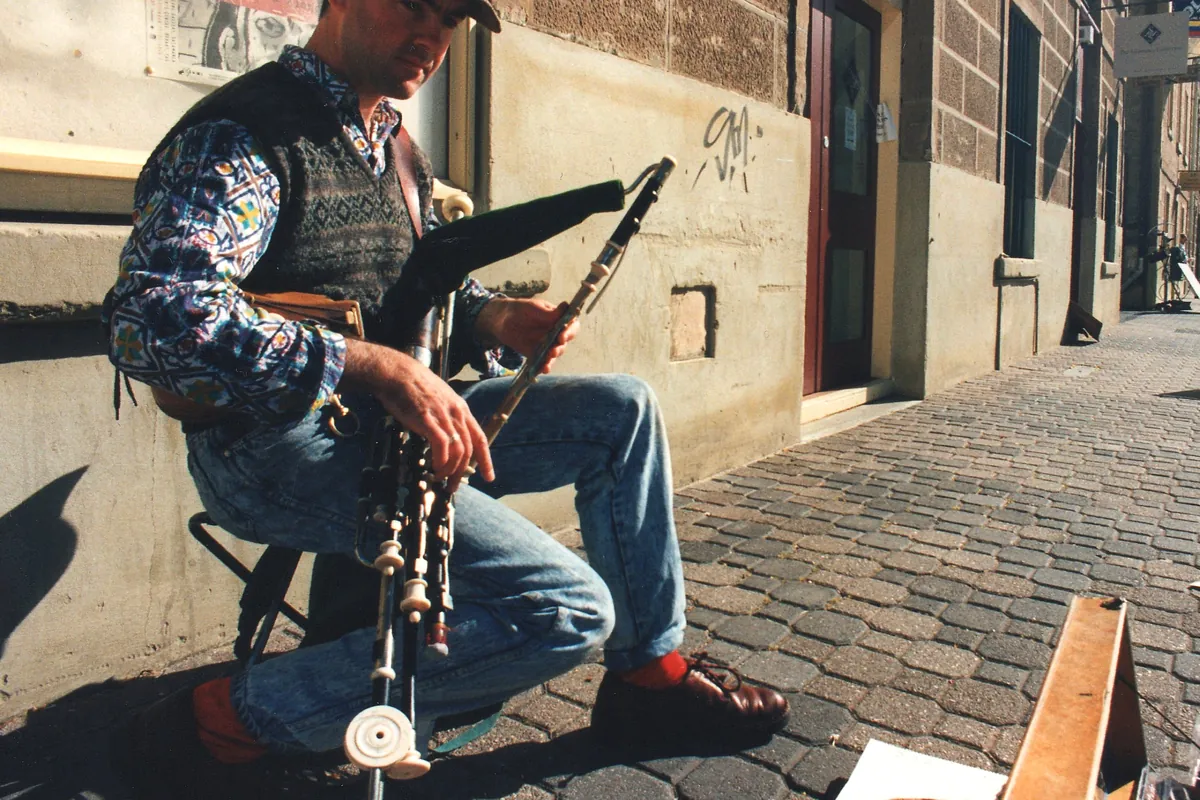
The uilleann pipes are Ireland's own bagpipe, and they look nothing like a marching piper's. The player sits, pumping a small bellows strapped to the waist and arm, which fills the bag; the name comes from the Irish for 'pipes of the elbow'. The chanter plays the melody across two octaves, three drones sound constant notes spread an octave apart, and three keyed regulators let the piper add chords with a turn of the wrist. Na Píobairí Uilleann, the pipers' organisation, runs classes and an archive for the instrument.
The bodhrán
Strictly, the bodhrán is a frame drum: a skin, usually goat, fixed across one face of a wooden hoop, with the back left open so the player can press a hand inside to change the pitch and tone. It is struck with a small wooden beater called a tipper, usually made of ash, holly or hickory. Its origins are debated: one account links it to the farm riddle once used to sift grain, while another traces it to the tambourine in the nineteenth century. Either way, it is the drum you are most likely to hear keeping time under the melody.
Sources